
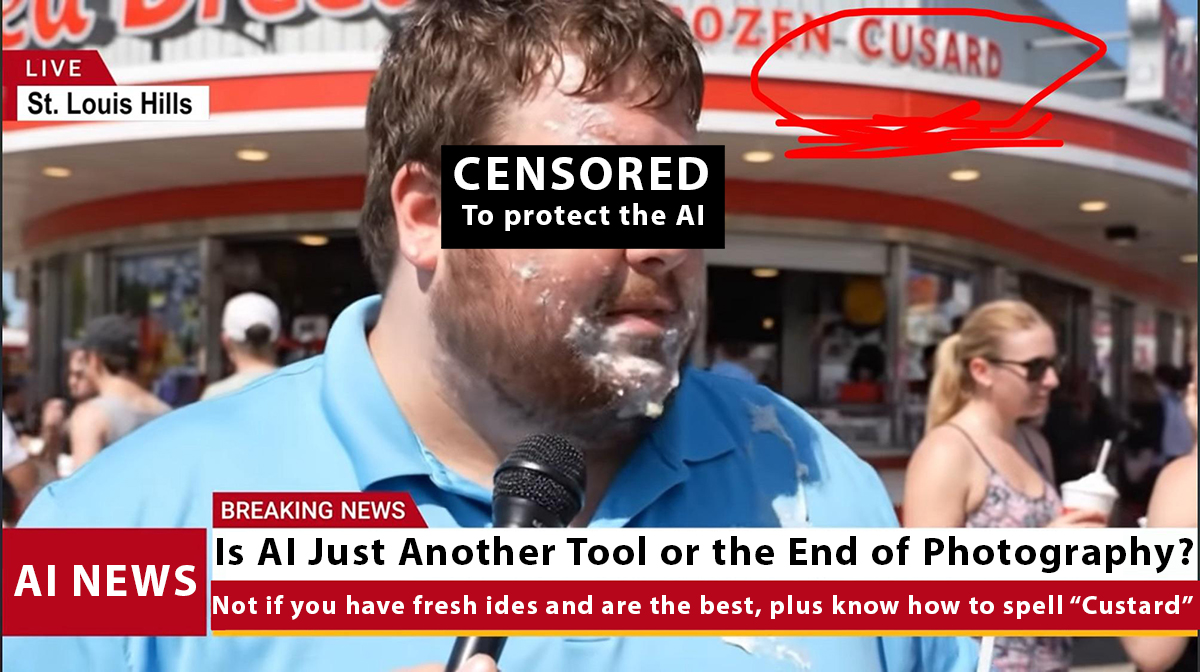
Over the last year AI has gone from a novelty that added extra hands to people in photos to what a lot of photographers are saying is the end of photography while others say “real”photography will always be needed. As usual, the truth lies somewhere in the middle and the “threat” is different depending on what you shoot. We will all be using some AI to increase our productivity if we use any post-production,and we should embrace this.
Yes, AI is a disruptor. Just as digital photography was a disruptor in the late 90’s. Back then a lot of shooters said digital will never be as good as film. As someone who shoots both film and digital and loves shooting film (until the bill comes), I can tell you digital is superior is basically every aspect except the experience. So as with digital, we should look at AI as just another tool in our kit and use it when it makes senses.
Let’s talk first about who AI will hurt and who should embrace it as just a tool. Who will win and who will lose if they don’t pivot.
Simple, Generic Product Photography
I’m talking about the Amazon and eBay type of product shooting. Simple strip out product, E-commerce photography. In the early 00’s when E-commerce was just getting off the ground I ran into the “just get it up” attitude. A lot of sellers don’t care about quality, the lunch lady can take the photos when they are not serving food. I joined a company where this was happening. With AI, they don’t even need to pay her to take the photos.
Stock Photography
If you are still trying to make a living as a stock photographer, it’s time to think about doing something else. Most stock photography is used in mock ups and for advertisement that is generic and with budget concerns, or they would send out armies of assignment photographers when they need a background photo of a lovely mountain range or well-to-do elderly couple walking along a beach holding hands in retirement bliss.
Stock shooters used to pull together a group of people and generate multiple variations on a theme like“diverse teams”, “doctors consulting patients”, or “golfing buddies on the green” in one shoot that would cost a few thousand, at tops, to produce a large body of work. It made financial sense. Buyers of such work wanted good looking shots as cheap as possible and they only wanted a look or feel, they didn’t care about the brand of clothing. Well AI can do that (just keep an eye out for extra hands or the thumb on the wrong size) at a fraction of the cost and the CFO loves it.
If you already have a large catalog, or it’s some niche subject that AI doesn’t have enough data (which it probably stole from stock photography) to come up with a realistic representation of the shot, you may be able to hang in there until you retire.But most will need to pivot.
Headshots
I’m not talking portrait photography, that is one field of photography that will always be around and where AI can help you be more productive, but more on that later. I’m talking about headshots for business cards (do people still have business cards) or for websites, LinkedIn profiles. Anyone can take a quick smartphone photo and have AI alter it to “look” like a business headshot.
Low Level Retouching
If you haven’t played with Photoshop’s AI subject selection tool, you need to and you will quickly understand why simple retouching is all but being taken over. AI is already taking over basic strip outs, culling, and color correction. Basic retouching is now just a click away.
What AI is not going to Replace
Photojournalism
As long as people want to hear and see what is happening, AI will never replace photojournalism because no one would trust what they are seeing. There is already an issue with this in politics and even some news reports are questioned. I took a photo of the aurora borealis last May down at the Arch. It was the first time someone questioned my work as AI. Even after I explained how to achieve the shot some people didn’t believe me and wanted me to send them the RAW files. I wouldn’t, even though it would end the debate, it would also give away the RAW and with the RAW someone could claim they took the shot.
Weddings and High-End Portraits
Again, like photojournalism,weddings are an event that AI will not be able to fake because there are too many individuals, and each event is unique so the AI will have little to build its images from. There are a few things AI just can do.
· Get an authentic expression
· Create an experience that brings people together and creates memories
· Collaborate on a creative experience
· Make people feel comfortable and relaxed
AI can create a beautiful portrait, but it can’t replicate the experience nor capture a natural expression and feel. These come through the skills of a professional photographer who not only knows how to get a correct exposure but can direct and pose the subject. AI can’t interact with someone in this way, to create something natural, spontaneous, and original. AI only copies and take cues from people input.
Commercial Photography
Some low-end commercial work may be replaced, and AI may help in the process of creating commercial work, the high-end work will still be safe. Coming from that world myself, the collaboration between photographer, art directors, clients, stylist, and even the lonely assistant, is something that will be hard to replace. The fluid flow of ideas, onset, between these collaborators is key in making great campaigns. AI isn’t at pre-production meetings where alternatives suggestions are made, problems flushed out and addressed, and these are key in high end commercial work. Also, onset or location, things that just happen that can add to a shoot will not accrue. I was on a swimsuit shoot when an old school dune buggy came by, we talked to the driver and they let us use it as a prop. It was never planned but ended up altering the whole shoot in a positive way.
AI is a Tool to Master
The reality is, AI is here, and we must adapt just like we had to adapt when digital came out. Those who learn to use it as a tool to make them more productive will continue to thrive. Those who do not adapt will go the way of film shooters in the 00’s.
Use Ai to help you collate through your images and speed up that process. Those retouchers who master how to use AI as a light touch, helping them speed up selection objects, removing unwanted distractions from an image in a realistic way, they will still have jobs. Use it as a way to speed up spec shots for proposals. These people are in a better spot.
Focus on skills we already have like.
· Strong client relationship
· Problem-solving
· Creative direction and story telling
· Knowing how to put a person at ease when they are not comfortable being photographed
· And using AI to improve your workflow
It’s time to take a hard look at your skill set and your business model. Identify if you are threatened by AI. Evaluate your business model and your workflow. Focus on building those things AI is not going to be able to replace and incorporate those things AI can help you with in order to spend more time in front of your clients and less time retouching. AI is not going to replace you if you make the changes, adapt, and focus on your strengths. Bring those skills to the table, the irreplaceable ones, and use AI to improve your workflow.
AI has gotten much better in such a short time, but luckily no one what’s to have AI in their ads, just check out the comments on anything with AI. It’s not the end, it’s just made the bar higher just like when digital took over and everyone said, “know anyone can do photography” and that was true at average levels. But if you were a good photographer doing high-end work, you probably got busier. AI will end some photographer’s careers, but if you sharpen your skill on focus on your unique look and style, plus you can deliver the goods you are in a good place. Just focus on being better than everyone else and keep exploring and coming up with new ideas.